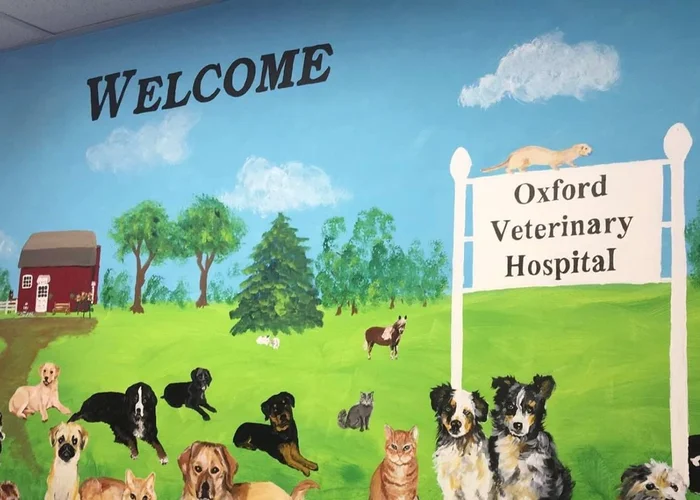
We have developed our services combining the recent changes in Veterinary medicine and the personal needs of your pet.  Our goal is to have your pet enjoy a healthy, happy, and long life.  Our charge is to prevent problems from developing.


Meet Noralie Damico.  With a great team to work with and her love for animals, she feels this is the perfect job for her.


  Local Emergency Hospitals
Should an emergency occur after business hours or on the weekend, please bring your pet to the Shoreline Animal Emergency.  Business hours are 24hrs per day, 7 days per week.
 

Shoreline Emergency Service

895 Bridgeport Ave

Shelton, CT  06484
 

Call: 203-929-8600


Need Directions?  Use the Map

                   Interactive Map


Vomiting
Vomiting occurs when there is an irritation to the front part of the bowel and generally takes three days to heal. In most cases, an immediate examination is not necessary even if there is a small amount of blood. The presence of a small amount of blood indicates an irritation to the wall of the stomach and requires a longer period of medication.

A visit to the veterinarian is recommended if you see a large amount of blood, if you pet seems sleepy or depressed (in addition to vomiting), or if there is no improvement in 12-24 hours after starting the recommended treatment.
Hospitals that offer 24-hour service are listed at the bottom of this page.

At home, you may treat your pet with Pepto-Bismol (he may throw up the first and second dose). Large dogs should get 1 tablespoon 3 times a day and small dogs should get 1 teaspoon 3 times a day. You should withhold food and water for 24 hours. Once this has passed, you may feed the same diet as recommended for diarrhea.

Diarrhea
As most pet owners know, diarrhea is a common affliction. In most cases, it is not serious and can be treated at home. However, if more than a few drops of blood are seen in the stool, or if your pet does not show signs of improvement in 12-24 hours, a visit to the veterinarian is recommended. Hospitals that offer 24-hour service are listed at the bottom of this page. At home, you may treat your pet with either Pepto-Bismol or Imodium.

  • Pepto-Bismol – Large dogs should get 1 tablespoon 3 times a day and small dogs should get 1 teaspoon 3 times a day.
     
  • Imodium – Determine the proper dose for your pet’s weight and administer twice a day (i.e. a 40 lb dog should get ¼ of the recommended adult dose).
    Feed a bland diet consisting of 3 cups boiled rice with one cup boiled hamburger or chicken. Be sure to cool the meat and remove the fat.

Diarrhea and Vomiting
If your pet is nauseous and the cause of the vomiting reaches the intestines, diarrhea will follow and complete recovery will take about one week. In most cases, you may treat you pet at home. A visit to the veterinarian is recommended if you see more than a few drops of blood in the stool or the vomit, your animal seems depressed and sleepy, or there is no improvement in 12 –24 hours.
 Home treatment is the same as above.

Hospitals that offer 24 hour service are listed below.

Cuts and Scrapes
Minor scrapes and cuts can be treated at home by applying pressure (with a towel or gauze) to stop the bleeding, cleaning with a mild detergent, applying Bacitracin and a bandage. Remember to tape the bandage to your pet’s fur and change it regularly to keep it clean. If you are unable to stop the bleeding, or the cut appears red and puffy or has a discharge, your pet should see a veterinarian as soon as possible.

Hospitals that offer 24 hour service are listed below.

Abscess
Abscesses occur most often when a bite wound becomes infected, and they can lead to high fevers and large swellings. If you notice a swelling, especially on the face or paws, your pet may have an abscess. Abscesses need to be drained quickly; a visit to the veterinarian is recommended as soon as possible.

Hospitals that offer 24 hour service are listed below.

Problems Urinating
Dogs – Urinary problems in dogs occur primarily in males. If your dog is straining to urinate but is unable to produce more than a dribble, he may have a stone blockage behind the bone in the penis. This is a very serious condition; if left untreated, your dog may die. Bring him immediately to your veterinarian or emergency hospital.

Hospitals that offer 24 hour service are listed below.

Cats – Occurring almost exclusive in male cats, a blocked cat will strain to urinate, often produce bloody urine and will emit high-pitched ‘yowls’ while trying to urinate. The blockage may be caused by a stone or other obstructions. This is a very serious condition; if left untreated, you cat may die. Bring him immediately to your veterinarian or emergency hospital.

Hospitals that offer 24 hour service are listed below.

Upper Respiratory Infection
This type of infection is common to kittens, but may be contagious to others. Therefore, beginning treatment in a timely manner is important. The symptoms of this condition include coughing and a colored discharge from the nose and eyes. If your pet is exhibiting these symptoms, he is very sick and should see a veterinarian as soon as possible.

Hospitals that offer 24 hour service are listed below.

Heat Stroke
With excessive heat, lack of shade, lack of water or if it is humid outside, your pet can suffer form a heat stroke. If you suspect this, move your pet to a cool area and immediately bathe your animal with tepid water. If possible, monitor your pet with a rectal thermometer and when it drops to 103 F you can dry your pet. You should bring your pet to your veterinarians or an emergency clinic immediately!

Hospitals that offer 24 hour service are listed below.

Choking
Everyday your pet has to eat and probably has a chew toy to play with. One of these days your pet will probably end up choking on the object whether it is food or the toy. If you notice choking, gently pull the tongue out and inspect mouth and throat. When the foreign object is found you should attempt to remove it by hand or tweezers. Try not to push object farther down the animals throat. If you can't retrieve the object you should bring your pet to your veterinarian or the emergency clinic immediately!

Hospitals that offer 24 hour service are listed below.

Bee or Wasp Stings
If you notice that your pet has a bee sting you can neutralize it with baking soda because bee stings are acid. Apply a cold pack and calamine or antihistamine cream and watch.
A wasp sting is Alkaline that can be neutralized with vinegar or lemon juice. Also apply a cold pack and calamine or antihistamine cream on the spot and watch. If your pet is swelling severely or has difficulty breathing bring to your veterinarian or emergency clinic immediately!

Hospitals that offer 24 hour service are listed below.

Poisons
There are many things that may be poisonous to your pet. Some of the more common items include antifreeze, chocolate, many houseplants and owner’s medicines. If you think your pet has ingested something poisonous, contact your veterinarian or emergency hospital immediately.

Hospitals that offer 24 hour service are listed below.  Also, the poison control number for animals is 1-(888) 426-4435.

Torsion
Torsion occurs when there is a buildup of gas in the stomach, causing the stomach to turn. Symptoms include a swollen stomach, especially halfway between the front and rear legs, discomfort (your pet may not want to sit or lay down) and an inability to keep down anything given orally. This is a very serious condition; if left untreated, your pet may die. Bring him immediately to your veterinarian or emergency hospital.

Hospitals that offer 24 hour service are listed below.

CPR (cardiopulmonary resuscitation)
If your pet is not breathing due to unconsciousness or choking you can follow these steps to resuscitate him:

  1. Lay your animal on his side and remove any obstructions in the airway (open the mouth, pull tongue forward, extend neck, and sweep mouth with finger).
  2. If airway is clear, extend neck, hold tongue out of mouth, and close animals jaws over tongue.
  3. Holding jaws closed, breathe into both nostrils for 5 to 6 breaths. If there is no response, continue artificial respiration. If there is also no pulse, begin cardiac compressions.
  4. Depress widest part of chest wall 1.5 to 3 inches with one or two hands.
  • Dogs over 60 lbs = 60 times/min.
  • Animals 11 - 60 lbs = 80 - 100 times/min.
  • Animals 5 - 10 lbs = 120 - 140 times/min.
  • For very small animals(1-5 lb), place hands around rib cage and apply cardiac massage.
  1. Continue artificial respiration.
  • Dogs over 60 lbs = 12 breaths/min.
  • Animals 11 - 60 lbs = 16 - 20 breaths/min.
  • Animals less than 10 lbs = 30+ breaths/min


Copyright © 2005-2006 Oxford Veterinary Hospital P.C.  All rights reserved.   |   Terms of Use     Privacy Policy
Website Design and Hosting provided by Stratagem Technical Services